Davos 2026: What the World Economic Forum Reveals About Interest Rates, Geopolitics, and Innovation – and Why Gold is Currently Hitting Records
January 22, 2026
When discussions in Davos become more intense, they are rarely just about pleasant-sounding themes. The World Economic Forum (WEF) is scheduled for January 19 to 23, 2026, under the motto "A Spirit of Dialogue." According to the WEF, nearly 65 heads of state and government as well as almost 850 CEOs and chairmen will gather there this week.
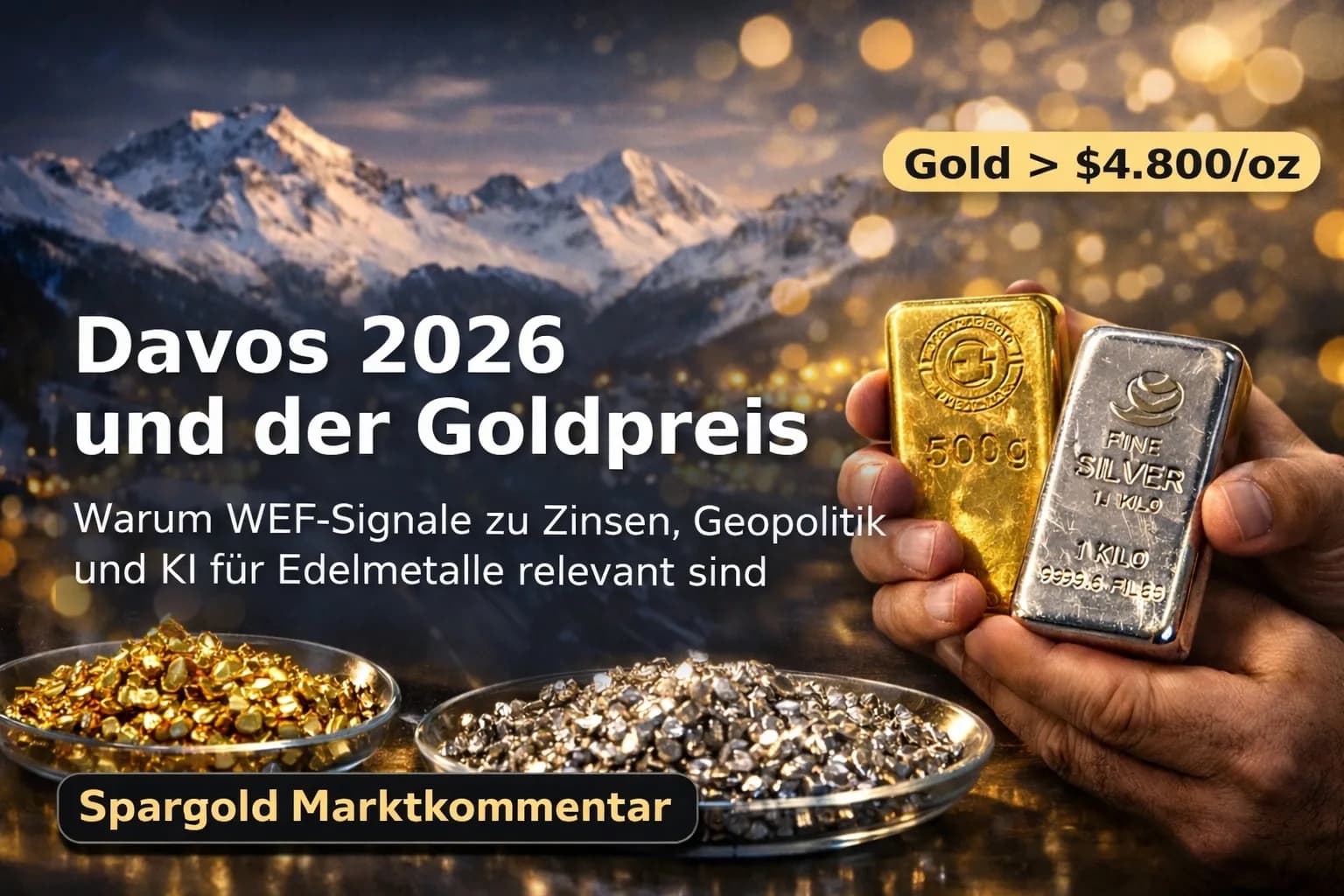
Parallel to this, something is happening in the markets that makes even experienced observers take notice: On January 21, 2026, gold exceeded the mark of 4,800 US dollars per ounce for the first time. Just the day before, new records for gold (over 4,700 US dollars) and an all-time high for silver were reported. Davos and the record gold price are not causally linked, but they reflect the same core: a phase of increased uncertainty in which trust, liquidity, and political capacity to act are becoming more expensive again.
Davos is not a market indicator like a central bank decision. However, it is a seismograph for topics that are later translated into laws, regulations, investment programs, and budget priorities. Precisely because politics, large corporations, science, and the financial world discuss simultaneously in Davos, a common narrative often condenses there about what is considered a "risk" and what is evaluated as "resilience."
In 2026, the WEF explicitly places the debate in the context of fragmentation, technological acceleration, and geopolitical reorganization. The official fields of discussion are five global challenges: cooperation in a competitive world, new sources of growth, investing in people, responsible innovation, and prosperity within planetary boundaries. These headings sound broad, but they are surprisingly concrete for precious metals because they are directly related to inflation expectations, real yields, and currency and trust issues.
Several reports depict Davos 2026 as a conference in a "complex geopolitical environment." The WEF itself speaks of one of the highest-level gatherings in the history of the meeting and emphasizes the special geopolitical situation. Media reports also point to an environment in which tariff debates, conflict lines, and new projections of power are once again more prominent on the agenda.
For precious metals, this is relevant because geopolitical uncertainty typically generates a safety premium. This premium is evident not only in short-term price movements but also in how institutional investors evaluate hedging costs and liquidity reserves. The fact that gold is reaching new historical marks during this very week fits into this picture.
In Europe, the key interest rate framework remains a central reference point. The ECB has reported a rate of 2.00 percent for the deposit facility since June 11, 2025. For gold logic, the nominal interest rate is less decisive than the real yield—that is, the nominal interest rate minus inflation expectations. When real yields fall or become uncertain, the relative attractiveness of gold as a "non-interest-bearing" store of value often increases. Conversely, a clearly rising real interest rate level can mean headwinds.
Davos rarely provides new interest rates on this point, but it provides the framework of reasoning: How do top politicians and business leaders assess growth, supply chains, energy prices, and geopolitical risk premiums? Depending on how these factors are discussed, expectations regarding inflation and monetary policy shift.
In 2026, the WEF explicitly places innovation in the context of responsibility and trust. At the same time, the debate surrounding AI, regulation, and competitiveness shows that the digital financial infrastructure continues to be in transition. Al Jazeera also describes that in Davos 2026, topics ranging from geopolitics to AI and climate are being discussed in more than 200 sessions.
For a FinTech audience, this is an important point: As digital systems become more complex, the importance of transparency, auditability, and counterparty risks increases. From this perspective, precious metals are not a "counter-model to digitalization" but rather a building block for robustness in portfolios and balance sheet structures, precisely because they do not depend on software updates or platform risks.
| Davos 2026 – Official Field of Discussion | Market Mechanics Behind It | Why This Can Be Relevant for Gold and Silver |
|---|---|---|
| Cooperation in a Competitive World | Fragmentation, trade risks, risk premiums | Higher uncertainty often increases demand for "safe-haven assets" |
| Unlocking New Sources of Growth | Productivity, investment cycles, energy prices | Growth expectations influence interest rate and inflation expectations and thus real yields |
| Investing in People | Labor market, wage development, social stability | Wage and stability issues have long-term effects on inflation and political risk premiums |
| Deploying Innovation Responsibly | AI, regulation, systemic risks | Trust in systems becomes a core resource; physical assets often benefit from trust debates |
| Prosperity Within Planetary Boundaries | Energy and raw materials policy, supply chains | Raw material and energy costs affect inflation and industrial demand (silver is more industrially driven) |
A record price is not "proof" of a coming direction, but it is a signal that the market is currently willing to price uncertainty higher. Reuters explicitly categorizes the jump over 4,800 US dollars per ounce on January 21, 2026, as a safe-haven movement in an environment of global uncertainties. The fact that new highs for silver were also reported in the same news cycle reinforces the statement: In addition to safety, the narrative surrounding industrial demand, technology, and energy policy can also play a role.
For investors, this means one thing above all: In phases where interest rates, geopolitics, and technology are simultaneously perceived as sources of uncertainty, diversification is once again understood less as optimization and more as risk management.
Davos generates conversational density, but no instructions for action. Those who use precious metals typically do so not because of individual conference days, but because of structural functions: preservation of value over long cycles, robustness against extreme events, and a counterpoint to purely financial promises. In weeks like this, when political and economic tensions become visible and gold enters new price zones, it is worth taking a calm look at one's own risk profile and the question of what role real assets should play in the overall picture.
Davos 2026 provides a precise coordinate system for this: cooperation versus fragmentation, growth versus distribution, innovation versus trust. It is precisely in these areas of tension that the broad lines for interest rates, inflation, and geopolitical risk premiums will be decided in the coming months.
Stay far-sighted, Yours Helge Peter Ippensen