Bonded Warehouses as a Safety Net: Why the Storage Function is More Important for Industry Than Any Tax Debate

April 23, 2026
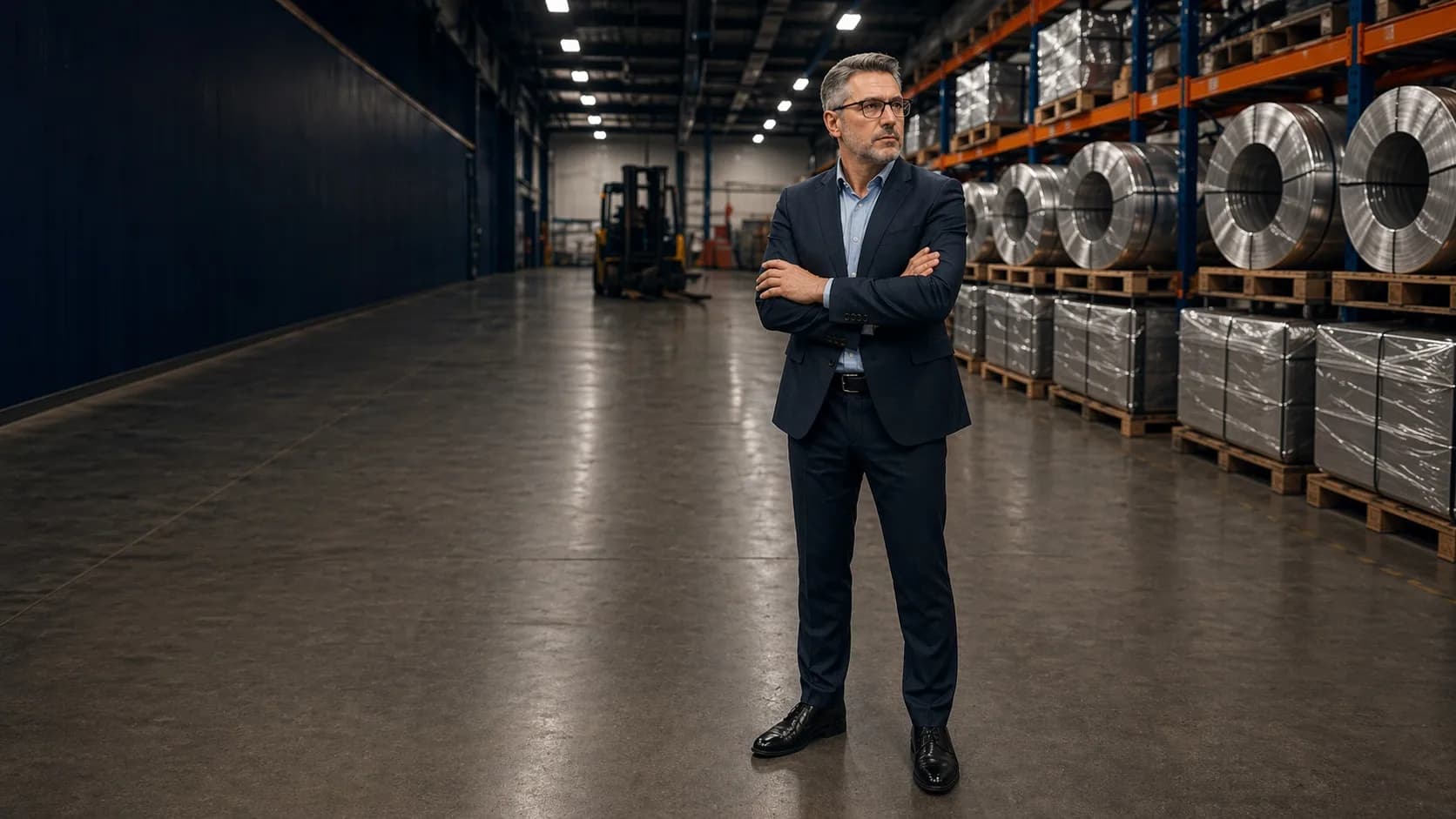
The discussion regarding the new interpretation of the VAT exemption for import-related deliveries is currently loud, particularly from an investor's perspective. However, for industry, the term “bonded warehouse” represents something more fundamental: an instrument for security of supply, liquidity, and predictability in global supply chains. Especially with metals and critical raw materials, storage capacity is not a “nice-to-have” but a competitive factor – because production lines do not wait for political frameworks to stabilize.
On April 9, 2026, the Federal Ministry of Finance (BMF) further specified the tax exemption according to § 4 Nr. 4b UStG, linking it more closely to the actual import into free circulation under customs or tax law. (bundesfinanzministerium.de) The fact that the first market participants subsequently halted transactions shows: when rules affect supply chain processes, things become operational. (handelsblatt.com)
Industrial companies do not use customs and bonded warehouses primarily to “circumvent” duties, but to manage goods flows. Raw materials and metals often come from third countries, pass through several processing steps, are tested in batches, and only then are transferred into specific production processes. It is precisely during this period that storage capacity is the lever that turns uncertainty into the ability to act.
The logic is simple: those who already have access to material can cushion bottlenecks, carry out quality controls properly, and pace production reliably. Those who only purchase material when the need is acute bear the full risk of delivery times, export restrictions, logistical disruptions, and price volatility.
The extent to which raw materials have become a question of economic security is shown by a current example from today: Norway's government is taking over the planning for the Fen deposit, which is considered Europe's largest rare earth deposit. According to a revised estimate, the deposit contains 15.9 million tons of rare earth oxides; around 19 percent of this is NdPr (neodymium/praseodymium), central elements for e-mobility, wind power, electronics, and also defense. Production start is not expected until the end of 2031, with a target of 800 tons of NdPr from 2032 – about 5 percent of EU demand. (reuters.com)
These figures are a reality check: even if Europe accelerates projects, new supply does not emerge “next month.” Industry must therefore bridge the gap – and that is exactly what storage and bonded warehouse structures are built for.
A bonded warehouse can link the payment dates of customs duties and import VAT to actual demand. This is not a cosmetic optimization, but a liquidity lever – especially with large import volumes. At the same time, storage under defined conditions enables clean specification and quality management: in many industries, a material batch determines scrap rates, warranty risks, and delivery capabilities.
In practice, this creates a triad: securing supply, not tying up capital unnecessarily, and keeping production flexible. And the more supply chains are under geopolitical tension, the more valuable this flexibility becomes.
The following simplified calculation does not show “profit,” but timing: the difference lies in the capital commitment at the time of import, when goods are initially stored and only later actually released into free circulation. Specific rates and procedures depend on the individual case.
| Position | Immediate import into free circulation | Storage with later release (timing effect) |
|---|---|---|
| Value of goods (example) | 10,000,000 € | 10,000,000 € |
| Customs (example 4 %) | 400,000 € due immediately | 400,000 € due only upon release |
| Import VAT (example 19 %) | 1,900,000 € due immediately | 1,900,000 € due only upon release |
| Liquidity burden upon import | 2,300,000 € | 0 € until release |
| Effect | Immediate capital commitment | Demand-oriented capital commitment |
Automotive, electronics, mechanical engineering, chemicals, energy, and grid technology have one thing in common: production downtime is more expensive than storage costs. If a single material is missing, it is often not just one product that stops, but an entire process chain. In such systems, the storage function is an operational insurance policy.
At the same time, the global race for critical raw materials is intensifying. The fact that Norway is “ramping up” a strategic project politically is a symptom of this development. When new extraction takes years, inventories, storage processes, and security of access become part of industrial policy – even if they are formally organized by the private sector. (reuters.com)
The BMF links the tax exemption according to § 4 Nr. 4b UStG more closely to an actually intended import in its application. (bundesfinanzministerium.de) For industrial supply chains, where goods are actually transferred into production and sales markets, the storage function remains fundamentally relevant – however, the need for clean documentation, clear process chains, and robust evidence increases.
The central message is therefore not: “Bonded warehouses are disappearing.” The message is: those who use storage structures must link them more closely to real-economy processes and map them cleanly in terms of regulation. Today's market reaction, with dealers halting transactions, is in this sense a short-term adjustment to new interpretative certainty. (handelsblatt.com)
If raw material projects like Fen require lead times until 2031/2032, the present decides on storage, access, and planning. Bonded warehouses are in this world not a niche instrument, but an element of industrial resilience: they combine material availability with financial controllability and stabilize production chains in uncertain times.
Stay forward-looking, Yours Helge Peter Ippensen