Aqua Regia, Nobel Prizes, and the Chemistry of Resistance: How Gold "Disappeared" in 1940

January 23, 2026
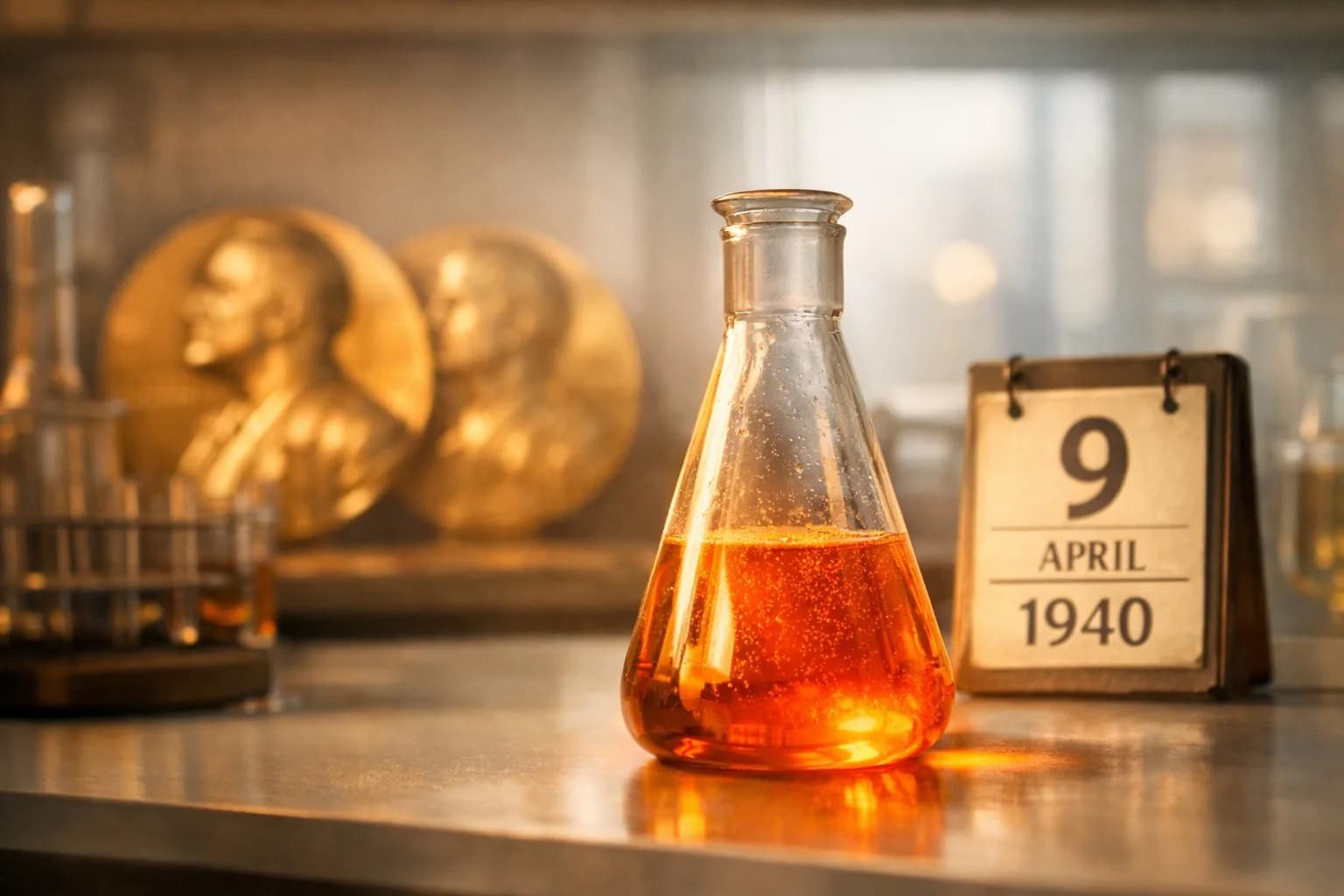
Gold is considered “indestructible.” It does not rust, hardly corrodes, and reacts with many substances practically not at all. It is precisely this inertia that makes gold a symbol of stability to this day – and in uncertain times, also a raw material that is closely monitored. All the more fascinating is that there is a classic liquid that can actually conquer gold: aqua regia.
On April 9, 1940, the day German troops invaded Copenhagen, two gold Nobel Prize medals were stored in the vicinity of Niels Bohr: the awards of Max von Laue (1914) and James Franck (1925). Both medals were more than metal; they were evidence of names, stance, and origin – and thus potentially life-threatening in a dictatorship. The plan to simply hide the gold was risky. So, they decided on a solution that was not political, but chemical.
Bohr's colleague George de Hevesy suggested not hiding the medals, but dissolving them. What sounds like an act of destruction was in truth an act of preservation. For gold does not disappear – it changes its state.
Aqua regia is a mixture of concentrated nitric acid and hydrochloric acid, classically in a ratio of about 1 to 3. Each acid on its own hardly attacks gold. Together, however, a chemical mechanism is created that releases gold from its inertia: nitric acid provides the oxidation, while hydrochloric acid provides chloride ions, which immediately bind and stabilize the resulting gold ions. The result is a yellowish to orange solution in which gold is no longer visible as a metal but exists in dissolved form.
It was precisely this inconspicuousness that became a shield in the spring of 1940. During later inspections, no piece of gold, no medal, no clear evidence was found – only a laboratory vessel containing liquid. The Nobel Prizes were there, but no longer recognizable.
After the war, de Hevesy returned, recovered the gold from the solution, and handed it over to the Nobel Foundation. New medals were struck. The story is so powerful because it does not romanticize gold but makes it tangible: gold is value because it is rare and accepted – and because it remains physically stable, even if it temporarily becomes invisible.
The composition of the Nobel Prize medals is also an exciting detail. Today, the medals in the classic categories consist of 18-karat recycled gold and are additionally plated with 24-karat gold; the target weight is 175 grams. This illustrates how closely history, symbolism, and material are linked – down to the measurable gram specifications.
| Key Metric | USD per Troy Ounce | EUR per Troy Ounce |
|---|---|---|
| Current (Jan 20, 2026) | 4,758.55 | 4,059.35 |
| Daily High | 4,766.24 | 4,065.30 |
| Daily Low | 4,660.48 | 4,004.80 |
| Change vs. Previous Day | +87.66 | +49.35 |
| Feature | Value |
|---|---|
| Material (today) | 18-karat recycled gold, 24-karat plated |
| Target weight (classic medals) | 175 g |
| Calculated gold content value (18K = 75%) | approx. 131.25 g |
| Diameter | 66 mm |
When gold sets new records today, safety is often discussed. The episode from Copenhagen shows a rare, almost poetic truth behind the physics: gold is not just jewelry or an investment. It is chemistry, history – and sometimes the most elegant camouflage in the world.
Stay farsighted, yours Helge Peter Ippensen